
You’ve typed some version of “why Kenya safari so expensive” into Google more than once, and the numbers still don’t make sense. A week can run $2,000 or $8,000 per person, and nobody tells you why. Most guides give you a vague list of “factors” and call it a day. I want to show you an actual ledger instead, the kind I go over with guests before they book, so you can see where a dollar on safari really goes.
Why Kenya Safari So Expensive: What Actually Drives the Price
Kenya’s safari camps sit far from anything resembling a supply chain. Fuel, food, linens, and spare vehicle parts get trucked or flown in over dirt roads that turn to soup in the rains. A camp in Naboisho Conservancy or along the Talek River in the Masai Mara has no mains electricity and no piped water. Solar arrays, generators, and borehole pumps all cost money to install and run.
Then there’s staffing. A good camp keeps one guide for every two to four guests, plus cooks, tent stewards, mechanics, and night watchmen. That ratio is what makes the game drives good, but it also means a 12-tent camp might employ 40 people.
Add park and conservancy fees on top, and you start to see why a week here costs what it does.
Park and Conservancy Fees: The Biggest Line Item
This is where most of the sticker shock starts. Kenya Wildlife Service raised non-resident park fees in October 2025, and the numbers matter for planning:
| Park or reserve | Authority | Non-resident fee (per adult, per day) |
|---|---|---|
| Masai Mara National Reserve | Narok County Government | $100 (Jan-June), $200 (July-Dec) |
| Amboseli National Park | KWS | $90 |
| Lake Nakuru National Park | KWS | $90 |
| Tsavo East / Tsavo West | KWS | $80 |
| Nairobi National Park | KWS | $80 |
| Chyulu Hills National Park | KWS | $40 |
| Naboisho / Mara North Conservancy | Private landowners | roughly $80-150, bundled into camp rate |
Note that the Masai Mara is not a KWS park. Narok County runs it, which is why its fee schedule and its price jump for the July to December migration season sit apart from every KWS park. If you want the fuller picture, how conservancy fees compare to national park fees breaks down why a private conservancy often costs more per night than the reserve next door, and what that extra money actually buys.
A Real Ledger: Where a $650 Night in Naboisho Goes
Here’s the part most blogs skip. Say you book three nights at a mid-range camp like Kicheche Valley Camp in Naboisho Conservancy, at roughly $650 per person per night, full board. Here’s a rough breakdown of that nightly rate:
| Cost component | Approx. share of nightly rate | Approx. USD |
|---|---|---|
| Conservancy fee | 20% | $130 |
| Guiding and camp staff wages | 23% | $150 |
| Food, drinks, laundry | 15% | $100 |
| Vehicle, fuel, transfers | 11% | $70 |
| Tents, power, water, overhead | 31% | $200 |
That’s a rough split, not a receipt, but it’s close to what operators actually work with. Notice how little goes to the tent itself. Most of your money pays people and permits, not canvas.
Now stretch that across a real trip. A six-night circuit, one night in Nairobi, three in Naboisho, two in Amboseli, at mid-range camps for two travelers, typically lands between $4,200 and $5,800 per person before international flights. Add a scheduled flight between camps instead of a road transfer, and add $150 to $300 per leg.
Cost by Safari Style
| Tier | Per person, per night (USD) | What you get |
|---|---|---|
| Budget | $150-300 | Shared or basic camps, group vehicles, road transfers |
| Mid-range | $400-700 | Naboisho or Mara North style camps, small groups, en-suite tents |
| Luxury | $800-1,200 | Low vehicle density, private conservancy access, top guiding |
| Luxury+ | $1,300+ | Private vehicle, private guide, exclusive-use camps |
Cost by Season
Kenya has a peak season from July through October, when the wildebeest migration crosses the Mara River and the Mara’s fee doubles to $200 a day. December through March is warm and mostly dry, with good game viewing at lower rates. April through May, the long rains, is the cheapest window, sometimes 30% below peak, though some camps close for maintenance.
What’s Included vs What’s Not
A typical quote covers accommodation, meals, game drives, park or conservancy fees, and a driver-guide. It usually excludes international flights, Kenya’s visa or travel authorization fee (about $52), gratuities, alcoholic drinks at some camps, laundry at budget properties, and extras like a hot air balloon over the Mara, which runs $450-550 per person.
Bring more cash than you think you’ll need for tips and small purchases outside camp. For a full plan on this, see how much cash to carry on safari.
Does the Vehicle Change the Price?
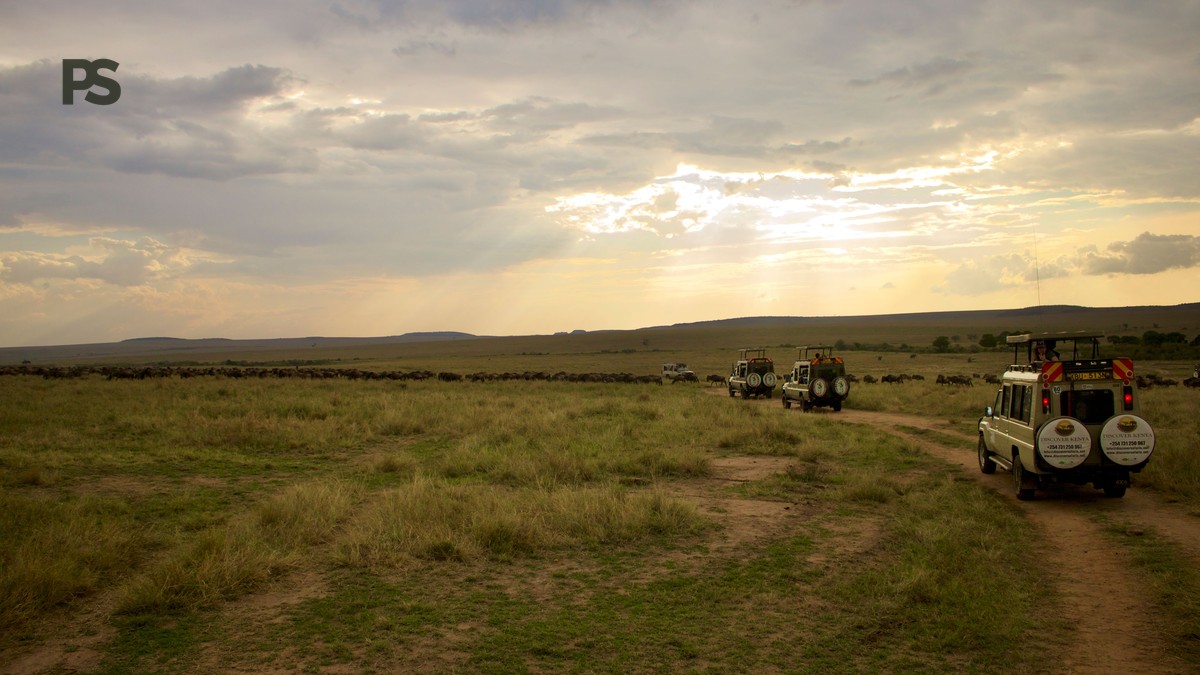
Guests ask this a lot. A Land Cruiser handles the Mara’s black cotton soil and river crossings better than a Land Rover, and camps that run Land Cruisers exclusively often price slightly higher because of maintenance costs and off-road capability. For the full comparison, read the real cost difference between a Land Cruiser and Land Rover safari.
Kenya vs Tanzania
Tanzania’s Serengeti and Ngorongoro Crater carry similarly high park fees, and Ngorongoro adds a crater descent fee on top. Kenya generally has a slight edge on value because its road network between parks is better developed, cutting flight costs, and its conservancy model gives you low vehicle density without crossing a border. Neither country is the cheap option. Both charge for the same reason: remote wilderness with limited capacity costs money to protect.
Ways to Bring the Cost Down
Travel in the green season if you can handle some rain. Book a conservancy camp with a shared vehicle instead of a private one. Travel as a group of four, since many camps price a shared 4×4 the same whether it holds two guests or six. Skip the balloon ride and do an early game drive instead, since first light at Naboisho or along the Ntiakitiak River in Amboseli often beats what you’d see from the air.
Solo travelers should expect a supplement, typically 20-50% on top of the per-person, sharing rate, since camps still have to run a vehicle and a tent for one guest.
The Trade-Off Nobody Talks About
Here’s the honest part. The cheapest safari usually means a shared vehicle with six to eight guests, national reserve only access with no conservancy time, and a driver working long days across multiple groups. You’ll still see lions and elephants. You’ll fight for window space and arrive at sightings after 10 other vehicles.
A $200 a night premium usually buys a conservancy with a strict vehicle cap, sometimes six vehicles per sighting instead of twenty, a guide who works for one camp and knows its territory, and walking safaris or night drives that national reserves don’t allow. That’s not an upsell trick. It’s a real difference in what your morning looks like.
The Plain Safaris Difference
We build itineraries the way this article breaks down costs: line by line, with real camps and real fees, not a vague quote. We tell you when a conservancy is worth the extra $150 a night and when it isn’t for your trip. We’ve driven the Nairobi to Narok road at dawn more times than we can count, and we know which camps near Naboisho and Amboseli deliver on quiet, low-traffic game viewing and which just advertise it.
Plan Your Trip
If you want a Kenya safari priced honestly, from the park fees to the vehicle to the camp, get in touch with Plain Safaris and we’ll build a real itinerary with you, line by line.