
Someone in my vehicle whispers “leopard!” at a shape in the grass eighty meters out, and half the time it turns out to be a cheetah with its head down, or the other way around. It happens to first-timers and to guides on a slow morning. The cheetah vs leopard spotting differences are simple once you know where to look, but at speed, in low light, with your heart going, they blur together fast.
I have spent enough dawns on the Naboisho and Ol Kinyei plains, and enough late afternoons easing along the tree line in Mara North, to know the tells that actually work from a moving vehicle. This is that field guide, built for photographers who want the right lens ready before the guide even finishes pointing.
The Cheetah vs Leopard Spotting Differences That Matter Most
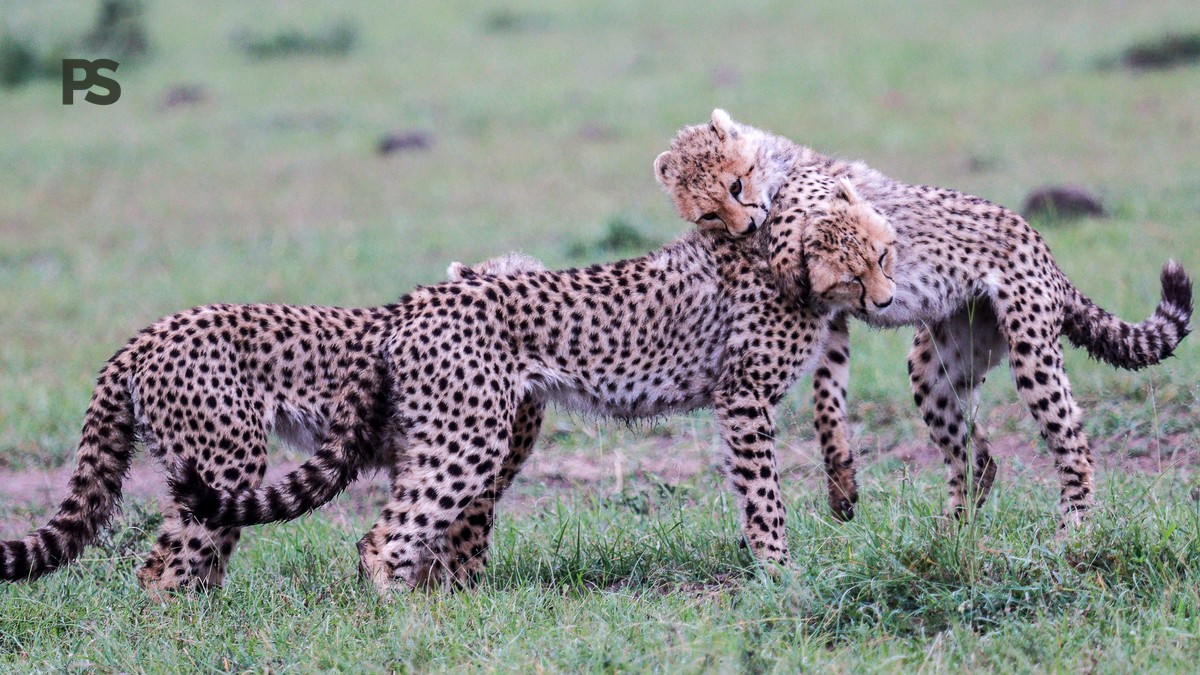
Look at the coat first. Cheetahs have solid, round black spots scattered evenly over a tawny coat, roughly the size of a coin. Leopards have rosettes, clusters of small dark marks arranged in broken circles, often with a lighter or rust-colored center. From twenty meters through a 400mm lens, that difference alone settles most arguments.
Then check the face. Cheetahs carry black “tear marks” running from the inner corner of each eye down to the mouth, like two thin lines of dried mascara. Scientists believe the marks cut glare from the sun during high-speed daytime hunts, the same idea behind a football player’s eye black. Leopards have no tear marks. Their face is broader, with a heavier jaw and a more compact, powerful head built for wrestling prey rather than sprinting it down.
Build, Head Shape, and Tail
Body shape confirms it if the coat and face are still unclear. A cheetah is built like a greyhound: long legs, a narrow waist, a small head, and a flattened, aerodynamic frame. A leopard is built like a boxer: thick shoulders, a stocky chest, short powerful legs, and a head that looks too big for its body.
| Feature | Cheetah | Leopard |
|---|---|---|
| Coat pattern | Solid round spots | Rosettes with darker rings |
| Face markings | Black tear marks under eyes | No tear marks, broader face |
| Body build | Slim, long-legged, narrow waist | Stocky, muscular, thick shoulders |
| Weight (adult) | 35-65 kg | 30-80 kg |
| Top speed | Up to 100-120 km/h in short bursts | Up to 58 km/h |
| Tail | Long, flattened, white-tipped, used for steering | Long and thick, used for balance climbing |
| Claws | Semi-retractable, always visible, used for grip while running | Fully retractable, sheathed when walking |
| Typical hunting time | Dawn and dusk, sometimes midday | Dusk through night, occasionally early morning |
| Social structure | Solitary females, males in coalitions of 2-3 | Almost always solitary |
The tail is a quick giveaway too. A cheetah’s tail is flat and rudder-like, with a white tip, and it whips side to side during a chase to help steer at full speed. A leopard’s tail is rounder and thicker, used mostly for balance when it climbs, which cheetahs rarely do. If you see a big cat draped over a sausage tree branch with a half-eaten impala nearby, that’s a leopard. Cheetahs are not strong enough climbers to haul a kill up a tree.
Claws and Tracks
If you’re photographing paw prints in the dust, the claw difference matters. Cheetahs have semi-retractable claws that stay exposed like a dog’s, giving them extra grip for sprinting. Leopard claws are fully retractable and sheathed while walking, so their prints show smooth, rounded pads with no claw marks. A cheetah track often shows faint claw indents ahead of each toe.
Hunting Style and Time of Day
This is the difference that decides your entire game plan. Cheetahs hunt by sight in daylight, mostly at dawn and dusk when it’s cool enough to run without overheating. A chase lasts seconds, rarely more than 300 meters, and ends in exhaustion for the cat either way. This is why our guides push for first-light departures when guests want cheetah action. You want to be out of camp and on the plains before 6:30am.
Leopards are ambush hunters, and mostly nocturnal. They stalk to within a few meters of prey using cover, then explode in a short, silent rush. Most leopard activity happens after dark or in the last hour of daylight, which is exactly why night drives matter so much for leopard sightings, and why reserves that ban them put you at a real disadvantage.
Habitat: Open Plains vs Wooded Cover
Cheetahs need open ground to run, so they favor short-grass plains with long sightlines. Leopards need cover to ambush and to hide kills from hyenas and lions, so they stick to riverine forest, thick bush, and rocky outcrops (kopjes).
In Kenya, this split plays out conservancy by conservancy. Naboisho Conservancy and neighboring Ol Kinyei Conservancy, both bordering the Masai Mara’s eastern side, are open rolling grassland with light vehicle traffic, which is exactly why they skew toward strong cheetah sightings at dawn. Mara North Conservancy and the denser riverine stretches along the Mara and Talek rivers hold more cover and more leopards, and both conservancies permit off-road driving and night drives, which the public Masai Mara National Reserve does not allow.
That last point matters more than most operators admit. Inside the Mara Triangle or the main public reserve, you’re restricted to daytime hours and marked tracks. Leopards there stay pushed into thick cover and are genuinely hard to find. If leopards are your priority, a private conservancy with night drive permits will beat the public reserve almost every time.
Solitary or Social
Leopards are near-total loners outside of mating and a mother raising cubs. Cheetahs are more social than people expect. Females are solitary, but young males often form coalitions of two or three brothers that hunt and travel together for life. Spotting three cheetahs moving as a unit across the Ol Kinyei plains is one of the more reliable “aha, those are cheetahs” moments, since leopards never move in a pack like that.
Where to Point Your Vehicle
Drive times and fees shape the trip more than most people plan for, so here’s what the logistics actually look like.
| Area | Best for | Approx. cost | Getting there from Nairobi |
|---|---|---|---|
| Naboisho Conservancy | Cheetah, open-plains dawn sightings | ~USD 80-150/person/night, bundled into lodge rate | ~40 min flight, Nairobi Wilson to Naboisho airstrip |
| Ol Kinyei Conservancy | Cheetah, quiet low-vehicle-density plains | ~USD 80-150/person/night, bundled | ~40 min flight to Naboisho airstrip, then 20 min road transfer |
| Mara North Conservancy | Leopard, dense riverine cover, night drives allowed | ~USD 80-150/person/night, bundled | ~45 min flight to Musiara airstrip |
| Masai Mara National Reserve (Mara Triangle) | Leopard, but daytime only, harder to find | USD 100/adult/day (Jan-Jun), USD 200/adult/day (Jul-Dec), set by Narok County, not KWS | ~45 min flight to Keekorok or Ol Kiombo airstrip |
That Masai Mara fee jump for July through December lines up with the wildebeest migration, when the reserve gets crowded and predators get harder to watch without a dozen other vehicles crowding the sighting. If you’re chasing cats specifically rather than the migration, a private conservancy often gives a calmer, more productive drive for less vehicle competition, even at a similar nightly cost.
Trying to optimize for both cats on the same short trip usually means seeing neither one well. A cheetah morning wants you parked on open grass at 6am with the light still low and gold. A leopard evening wants you idling near a riverbank at 6pm, waiting, sometimes for an hour, sometimes longer. Pick a conservancy that leans toward your priority cat and build the itinerary’s timing around it, rather than splitting each day between habitats that don’t overlap much.
For the gear side of this, our post on best camera settings for photographing fast-moving cats covers shutter speeds for a cheetah chase versus the low-light settings a leopard sighting demands. And if the timing of your trip is still open, our guide to best months for predator sightings and photography breaks down which weeks give you the clearest light and the driest, most open plains.
If you want to widen the search beyond these two, Laikipia holds some of the country’s most reliable spotting Kenya’s rarer predators in Laikipia, including African wild dogs, which run in packs and hunt in open daylight much like a cheetah coalition.
The Plain Safaris Difference
We build itineraries around which cat you actually want, not a generic “big five” checklist. If cheetahs are the priority, we route you through Naboisho or Ol Kinyei with dawn departures and camps positioned close enough to the plains that you’re not burning golden light on a long transfer. If leopards matter more, we place you in Mara North or a similar conservancy with night drive access, and we brief guides in advance on riverine stretches where leopards have been active that week. We keep vehicle counts low by working with conservancies that cap bed density, so a sighting stays a sighting, not a five-car pile-up.
Ready to plan a trip built around the cats you actually want to photograph? Get in touch through our Masai Mara safari packages page and we’ll help you pick the right conservancy and the right season.