
The camera settings safari game drives in Kenya actually require go beyond a generic Africa-wide checklist. Most guides for African safaris are written for no place in particular. They mix Kruger sightings with Serengeti light and call it done. Kenya has its own conditions: red dust in the Mara, heat shimmer over Amboseli’s swamps, a Land Cruiser’s pop-up roof vibrating under your elbows at 60 km/h. The right settings account for all of it, not just the animal in front of you.
Camera settings safari game drives need: start with Manual mode and Auto ISO
On a moving vehicle, light changes every few minutes as you turn between open plain and acacia shade. Manual mode with Auto ISO lets you lock shutter speed and aperture, the two settings that control sharpness and depth, while the camera handles brightness. Set a minimum shutter speed in your Auto ISO menu so the camera never drops below what you need for a moving subject.
Shutter speed by subject
A resting lion at 1/250s looks fine. A cheetah at full sprint at 1/250s looks like a smear. Match your shutter speed to what the animal is actually doing:
- Stationary or grazing animals: 1/500s
- Walking animals, elephants and giraffe included: 1/800s to 1/1000s
- Running animals, hyena chases, zebra crossings: 1/1600s to 1/2000s
- Birds in flight, especially lilac-breasted rollers and fish eagles over the Mara River: 1/2500s or faster
Vehicle vibration from an idling engine or an open roof hatch adds blur even to a stationary subject, so many Kenya-based guides keep shutter speed a stop higher than they would on solid ground.
Aperture for depth and separation
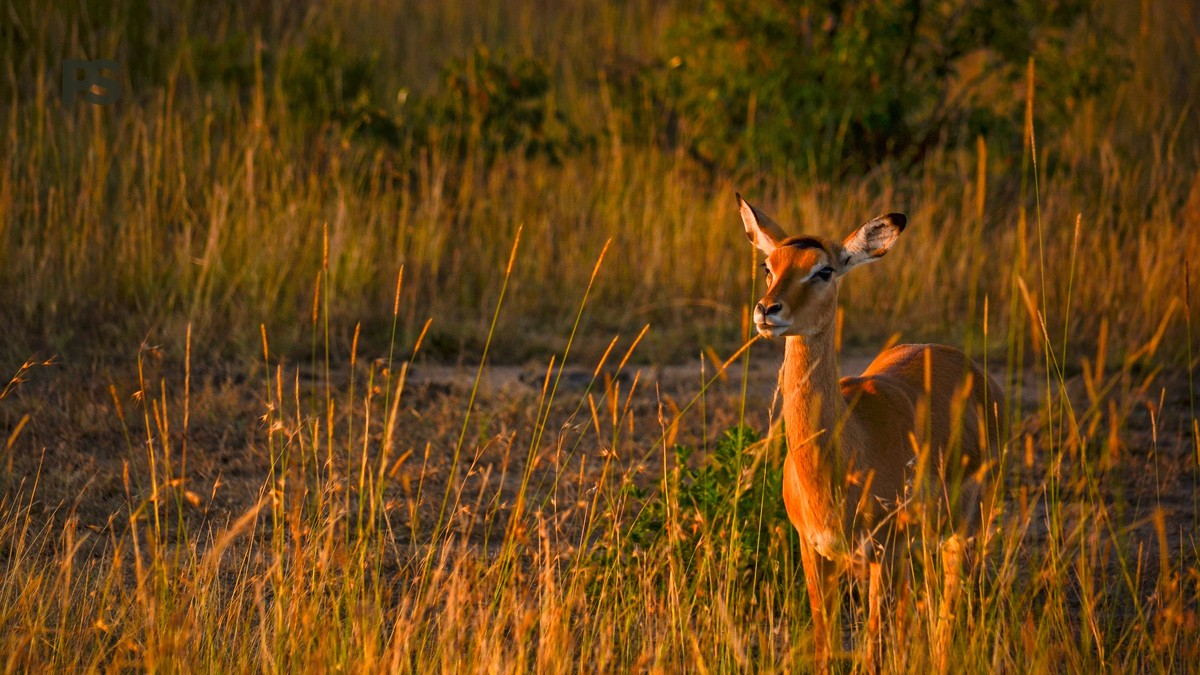
Wide apertures, f/4 to f/5.6 on most safari zoom lenses, blur the grass and bush behind an animal and put the focus where it belongs. Stop down to f/7.1 or f/8 for a family group or a pride with cubs, so more than one face stays sharp. Wide open apertures also help on overcast mornings in the Mara, which are common between June and September.
ISO and the noise trade-off
Kenya’s light swings hard between early morning and midday. At first light, before 6:45am in July, ISO can sit at 1600 or higher without a problem. By 9am under open sky, ISO 200 to 400 usually gets you there. Auto ISO with a capped maximum, most cameras allow this in the menu, stops the sensor from pushing past what you’re comfortable cleaning up in post.
Autofocus and eye detection
Continuous autofocus, called AF-C or AI Servo depending on the brand, is the only mode that keeps up with an animal walking through grass. If your camera has animal-eye detection, turn it on. It saves real time when a leopard’s face is half hidden by a branch, which happens often in the riverine forest along the Mara and Talek rivers. Back-button focus, separating focus from the shutter button, helps when you want to recompose without refocusing on the wrong tuft of grass.
Drive mode and buffer limits
Set your drive mode to high-speed continuous. A cheetah hunt lasts seconds, not minutes, and a single frame rarely captures the moment that matters. Know your camera’s buffer limit before you need it. Many mirrorless bodies slow down after 30 to 40 RAW frames in a burst, right when a kill or a river crossing is still unfolding.
RAW over JPEG, almost always
Shoot RAW. Kenya’s dust and haze shift color casts through the day, and RAW files hold enough detail to fix white balance and recover shadow detail from a backlit elephant at Amboseli, where Kilimanjaro’s outline often sits in haze by mid-morning. The trade-off is file size, which is why memory card planning matters more here than on a normal trip.
Metering and exposure compensation
Spot or center-weighted metering, aimed at the animal rather than the whole scene, keeps a dark-coated buffalo or a pale lion from confusing the camera’s exposure reading. Check your histogram, not just the screen preview, since Kenya’s midday sun makes LCD screens hard to trust. Dial in minus one-third to minus two-thirds exposure compensation for animals in bright, open grassland to avoid blown highlights on light fur.
Golden hour and where camps put you
Light matters more than gear. The hour after 6:30am and the hour before 6:30pm give warm, low-angle light that flattens dust and adds color to everything, from the black-and-white of a zebra to the gold of dry-season grass. Camp position decides how much of that light you actually get to use. A camp inside Naboisho Conservancy or Mara North puts you on the plains within 10 to 15 minutes of first light. A camp near one of the reserve’s main gates, Sekenani or Talek, can mean 30 to 45 minutes of driving before the light is any good.
Night drives, where they’re allowed
Kenya’s national reserves, including the Masai Mara National Reserve itself, do not permit night game drives. Private conservancies bordering the reserve, Naboisho, Mara North, and Olare Motorogi among them, do allow them with a licensed guide and spotlight. For night photography, raise ISO as high as your camera handles cleanly, open the aperture fully, and expect a shutter speed around 1/125s to 1/250s since red-filtered spotlights are dim by design and shouldn’t disturb the animal.
Protecting gear from dust and heat
Dust in the Mara during the dry season, July through October, gets into everything. A rain cover doubles as a dust cover, and a rocket blower beats compressed air for clearing sensors in the field. Heat is the other issue: a closed vehicle at midday can climb past 40°C, hard on batteries and hard drives alike. If you’re planning a multi-camp circuit that includes a bush flight, it’s worth checking how much camera gear you can actually bring on a bush flight, since most light aircraft cap checked bags at 15kg in soft-sided luggage only.
Lens choice for the vehicle you’ll actually be in
A 100-400mm or 200-600mm zoom covers most Kenya sightings without a lens change, which matters when a cheetah and a hornbill both show up in the same five minutes. Given bush-flight weight limits, one telephoto zoom and a wide-angle for landscape or vehicle shots is a more realistic kit than the three-body setup some gear guides suggest. Guides can also position the vehicle for a shot, but only if they know your focal length in advance, so tell them.
Comparing Kenya’s main photography destinations
| Location | Non-resident fee | Off-road & night drives | Drive time from Nairobi |
|---|---|---|---|
| Masai Mara National Reserve | USD 100/day (Jan-Jun), USD 200/day (Jul-Dec) | No | 5-6 hrs (270 km) or 45 min flight |
| Naboisho Conservancy | Roughly USD 80-150/night, bundled into lodge rate | Yes | 6 hrs (280 km) or 45 min flight to Mara North/Naboisho airstrip |
| Amboseli National Park | USD 90/day | No | 4 hrs (240 km) or 40 min flight |
| Samburu National Reserve | Indicative range, roughly USD 70-100/day, confirm before travel | No | 6 hrs (325 km) or 1 hr flight |
| Lake Nakuru National Park | USD 90/day | No | 3 hrs (160 km) |
Conservancies also cap vehicle numbers at a sighting, often five or fewer, which matters more for a clean photograph than almost any camera setting. A lion kill with fifteen vehicles around it rarely produces a usable frame.
Field checklist before you leave camp
Charge everything the night before. Most tented camps in the Mara and Samburu run generators for set hours rather than 24-hour power, so keeping camera batteries charged at safari camps takes some planning around those windows. Carry at least three memory cards and two spare batteries per person for a week-long circuit, and back up files each evening. Without a laptop, backing up your safari photos without a laptop is worth reading before you pack, since phone storage fills faster than most people expect on a burst-heavy trip.
The Plain Safaris Difference
We build photography-focused itineraries around light and quiet, not just wildlife checklists. That means camps set inside conservancies where off-road driving and low vehicle caps are the norm, drive times planned so you’re on the plains before sunrise, and guides briefed on your lens and shot list before the first game drive. We also know which camps have reliable charging windows and which routes suit a single-lens kit within bush-flight limits, so the logistics stay out of your way.
Frequently asked questions
What is the best camera setting for a safari game drive? Manual mode with Auto ISO, a shutter speed of at least 1/1000s, and continuous autofocus with eye detection where available.
Do I need a DSLR, or is a phone camera enough? A phone works for scenery and camp life, but wildlife at a safe distance needs a telephoto lens a phone can’t provide.
How many memory cards do I need? Plan for at least three per week if you shoot RAW and burst mode regularly.
What’s the best time of day for safari photography? The hour after sunrise and the hour before sunset, when light is warm and low.
Ready to plan a photography-focused circuit through the Mara, Amboseli, or Samburu? Get in touch with Plain Safaris and we’ll build the drive times, camps, and light around your camera bag, not the other way round.